
SUNDAY SCARIES: Happy Buying Season!
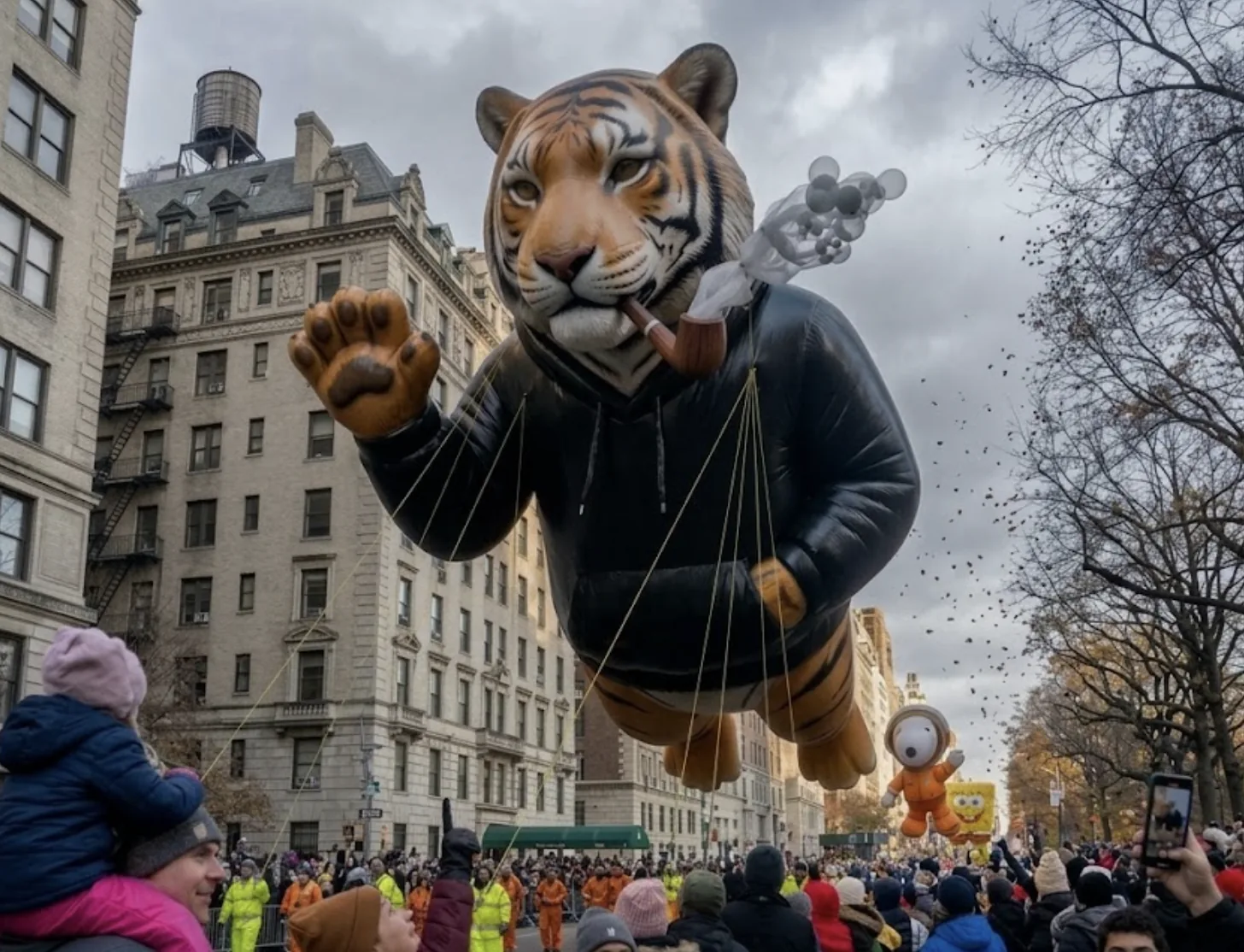
Ask any jaded social media expert or a brilliant young strategist like Eugene Healey whether brands change culture and you’ll get an eye roll or maybe even a matcha-filled spit take. And I would agree with them most of the time, like when a new creatine gummy brand can simply become part of pop culture by turning their name into a verb. It’s absurd.
But with the season that starts promptly on November 1st, the paradigm is nearly flipped. The date we eat turkey, the Thanksgiving celebration everyone watches religiously, the reindeer whose name everyone remembers, the biggest shopping day on the planet, and even the way Americans saved for Xmas lists for most of a century were all determined by a brand trying to sell something.
So, I would like to wish you all, Happy Buying Season!
1. Thanksgiving and Franksgiving
In 1939 Thanksgiving fell on November 30, which only left twenty-four shopping days until Christmas. It was the middle of the Depression, and retailers still kept an old custom of not advertising Christmas until after Thanksgiving so their season of shopping was shorter than they needed it to be.
Instead of starting his holiday sales and shopping earlier at risk of offending the public, Fred Lazarus, head of Federated Department Stores, (the company that would later become Macy’s, Inc.), persuaded President Roosevelt to actually move Thanksgiving up a week to November 23. The change was not lost on the American people and (while official records aren’t totally clear) the country split right down the middle when they celebrated that year.
Twenty-three states and Washington D.C. went along with the new date, twenty-two kept the old date, Colorado, Mississippi and Texas took both days off, and the mayor of Atlantic City, NJ started calling the new one “Franksgiving.”
But the change held and it took Congress until the end of 1941 to officially settle it as the fourth Thursday in November, starting in 1942. So Fred ultimately got his wish and that’s the Thanksgiving we’ve had ever since.
Takeaway: A department store moved the date of Thanksgiving.
(Sources: National Archives; History.com; New England Historical Society; Santa Fe New Mexican,)
2. Rudolph the Red Nosed Giveaway
Montgomery Ward is the original catalog company whose 1872 catalog predates even the Sears catalog. Like Sears, it offered people in rural America the chance to order dry goods and later included a log cabin, rifles, and even an automobile. Like Sears, it also built real stores and became the type of one stop shop for everything one might need. For a family-friendly atmosphere, it used to give out coloring books for free every Christmas to kids in its stores. In a cost-cutting epiphany in 1939, somebody decided it would be cheaper to write one themselves. Robert L. May, a 34-year-old copywriter, came back with a story about a reindeer named Rudolph that the others laughed at.
The story was loved by kids and Montgomery Ward gave away 2.4 million copies across the country that first year, (which was more than any children’s book publisher was printing at the time). Plans to print copies the following year were shelved by paper shortages due to World War II, and Rudolph remained on hiatus. When the reindeer story returned in 1946, it was more popular than ever as Montgomery Ward handed out 3.6 million copies of the book.
Then on January 1, 1947, in a shocking act of generosity after Robert May’s wife had died, Montgomery Ward president Sewell Avery transferred the copyright of the story from Montgomery Ward to Robert, free and clear. That’s also when the cash started to flow. Two years later May’s brother-in-law, Johnny Marks, turned the story into a song, which crooner Gene Autry recorded. It was the No. 1 song in the country the week of Christmas in 1949.
Ironically, the gift from Sewell Avery (who was not a good guy) ended up being worth far more than Montgomery Ward itself. Like Sears, it’s long gone, and in 2008, its name sold, bundled with two other catalog businesses, for $15.5 million, which by my (very) rough math is about what Rudolph brings in every year for the May family, who still own the rights for movies, songs, and more.
Takeaway: A catalog company invented Santa’s most popular reindeer.
(Sources: Wikipedia; Snopes; Library of Congress; GeneAutry.com; National WWII Museum; Chain Store Age)
3. Lonely Shopping Explosion
In 1993 four single students in a dorm at Nanjing University in China decided that November 11, or 11/11, a date that visually looks just like four people standing next to each other, should be a day for people like them. 11/11 was empowering and funny so “Singles Day” spread from campus to campus as a joke lamenting the plight of being single in a culture that prioritized couples.
In 2009 Daniel Zhang was in charge of the struggling ecommerce Taobao Mall at Alibaba. Desperate for something culturally interesting to spark sales, he turned Singles Day into a 24-hour bonanza that did about 50 million yuan, or $7 million. Jack Ma saw the potential and put his full support behind Zhang and Singles Day. With the sheer volume in a resurgent Chinese economy, by 2021 Alibaba alone was reporting $84.5 billion-with-a-B per year.
It’s so big that Alibaba and JD both stopped publishing their totals, but a conservative estimate puts last year’s around $150 billion across China. That’s more than twice the spending from Valentine’s Day, Black Friday, and Prime Day put together. And Singles Day is on track to eclipse ALL of our online holiday spending in the US in the next year or two.
Takeaway: An ecommerce site turned students’ cure for loneliness into a holiday bigger than Black Friday, Prime Days, and Valentine’s Day combined.
(Sources: Quartz; Wired; Bloomberg; CNN Business; South China Morning Post; China Daily and Syntun, November 13, 2025; eMarketer)
4. Christmas Clubs
In 1909 the Carlisle Trust Company in Carlisle, Pennsylvania, started the first Christmas Club, a savings account promotion where blue collar parents could feel good about putting in a little bit every week and get it all back on December 1st. Bank accounts obviously existed, but these working-class Americans were a demographic most banks had yet to tap. Though there was no additional interest or special deal, the people liked the idea of the commitment device, especially as it prevented their worse temptations to spend it early. The bank having it prevented mom from having to hide it herself and dad from taking the extra cash to the bar on Friday night.
About 350 people signed up that first year and saved roughly $28 each, and it spread like wildfire across America. For most of the century that followed, the bank’s Christmas calendar was a fixture of Norman Rockwell’s America and working families paid for the holidays that way. No one stopped to poke at the fact that their bank teaching them to wait until December also increased the bank’s capital reserves in Q3 and Q4.
At the same time, American prosperity was growing and the folklore about Santa’s Naughty and Nice lists was blended into a new American tradition of having children write lists of what they wanted Santa to give them (my lists always went through several drafts). And that’s why it’s no coincidence that parents’ gift savings account was created at the same time kids started wanting store-bought gifts.
Takeaway: Saving for your Christmas list was invented by a savings bank.
(Sources: Library of Congress; Rutgers New Jersey Digital Newspaper Project; Numismatic Bibliomania Society; Digital Commerce 360)
This Week’s Red Thread: Culture’s Tail Wags the Dog
In 1924 a lot of workers at Macy’s Department Store in Herald Square were first-generation immigrants (just like the rest of NYC at the time). They banded together and asked management for a parade like the ones they remembered from their childhoods in Italy and Germany. Instead of cracking down on the workers, Macy’s saw a win-win scenario. They could create a gift to their people and a way to bring the public to Herald Square.
In the first year of the “Macy’s Thanksgiving Day Parade” about 10,000 people marched six miles down from Harlem with animals borrowed from the Central Park Zoo, with roughly 250,000 people lining the route. At the end Santa arrived at the store on a sleigh made of ice, which officially kicked off the Christmas shopping season.
After a few years, Macy’s hired a puppeteer who had previously designed the store’s mechanical window displays to devise an alternative to the live animals, and that’s how the balloons came about. The parade is always free to attend, but only if you can get yourself to New York and pay the exorbitant holiday hotel prices. So it became the biggest passive viewing experience of the year, fitting perfectly with the typical family routine of cooking all day on Thanksgiving.
In 2016, while I was at R/GA, I got one of the more fun briefs of my career to feature the Google Pixel and Daydream View headset in a Verizon partnership around the holiday. To make the rarified experience of being there in person possible for everyone in America, my team led a partnership between Verizon, NBCUniversal, and YouTube, to broadcast the first 360º livestream of the Macy’s Thanksgiving Day parade - which required neither Verizon nor a Google Pixel to enjoy.
We put six 360º cameras along the route, from the top of the route, to the top of the 30 Rock marquee at the height of the balloons and street level at the corner of Sixth and 34th. People could use Google Cardboard and their phones to see the full experience and watch each of the balloons as they passed.
The social team in the broadcast van was swinging the cameras toward whatever people told us they wanted to see. Roughly 1.3 million people watched it live from their homes across the country, and every one of them felt like they had a spot along the route. (We were even allowed to tell Marlon Wayans and Olivia Culpo to keep their chatter to a minimum so people could look around, which Marlon did not appreciate).
I always look back at that activation with an amused pride as it was sort of like a commercial activation that democratized a commercial invention that itself was a democratized event, and so on, and so on.
Macy’s, NBCUniversal, Google and Verizon were all in it, not to mention all of the IP of every balloon and float and we just made it fun to watch. Meanwhile, as Verizon’s Black Friday push for the Google Pixel and the Daydream headset, our commercial breaks were 360º ads for both.
With AI, we are at the precipice of the season changing once again. Whether any of this has been good for us is very much up for debate, but the eye roll about brands changing culture misses how much of what we call tradition came out of a store, and how much of it people still love anyway.
This year Adobe expects Americans to spend $275.1 billion online over the holidays, and it expects retail traffic sent over from AI assistants to grow 130%, and 159% on Thanksgiving Day itself, which means a lot of people will be asking a chatbot what to buy while the turkey is still in the oven.
Makes you wonder: in 10 years, what frictionless holiday tradition will we be celebrating that was devised by our agentic shopping assistant?
— NB